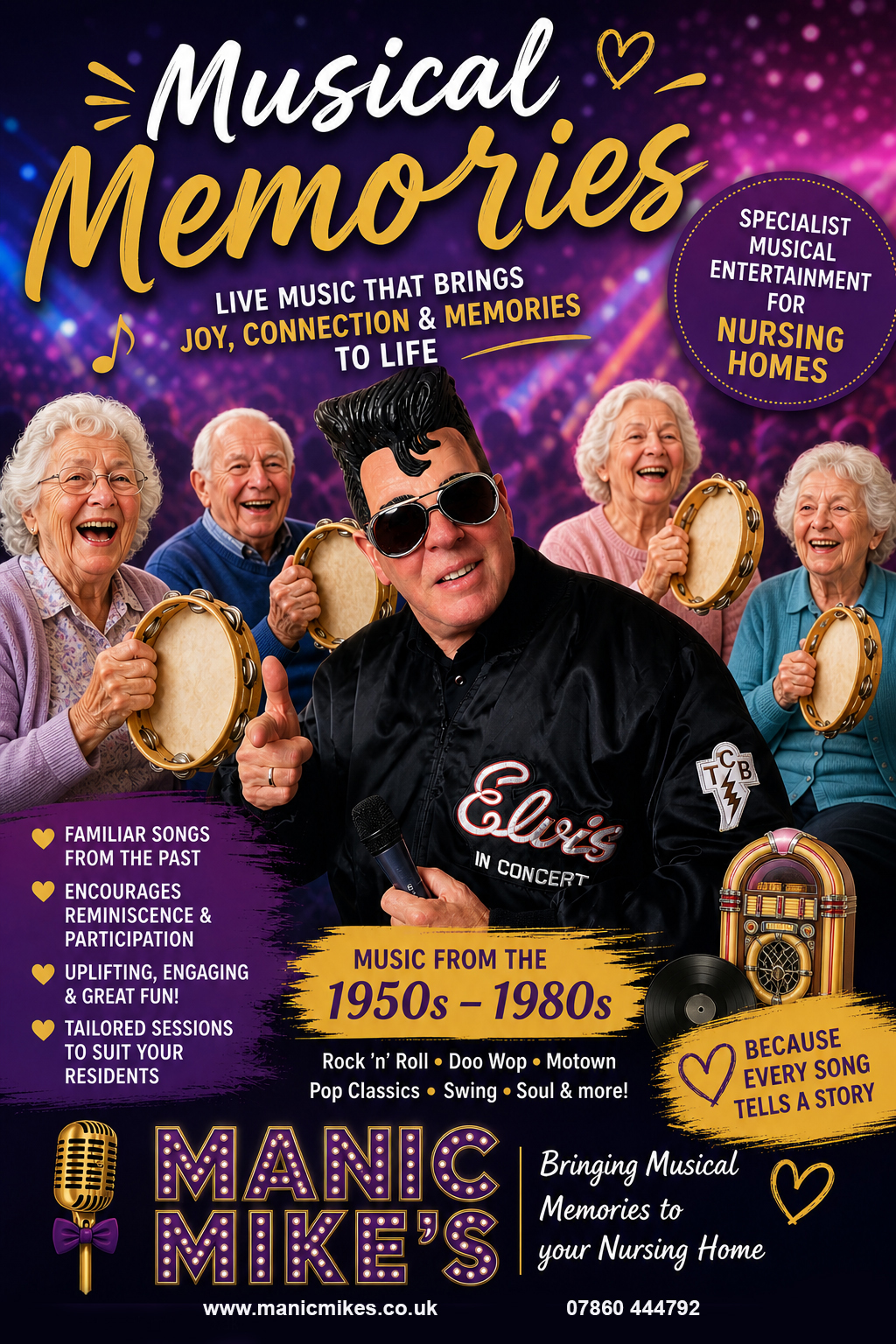
A quiet lounge at 2pm can feel very long indeed. Get the entertainment right, though, and the whole room changes - feet start tapping, faces lift, staff join in, and residents who were half-watching suddenly become part of the action. That is the real answer to how to entertain care home residents: do not just fill time, create moments people can join.
In care homes, the best entertainment is rarely the flashiest. It is the sort that meets people where they are, works for mixed abilities, and gives residents something familiar enough to feel safe and lively enough to feel special. If you are planning activities in Ashford, Maidstone, Folkestone or elsewhere in Kent, that balance matters even more when you are trying to please a whole room rather than one person at a time.
What works when thinking about how to entertain care home residents
The first thing to remember is that care home entertainment is not the same as putting on a party for a pub crowd or a wedding reception. Energy is still important, but pace matters too. Volume matters. Familiarity matters. Most of all, participation matters.
Residents do not all want to be entertained in the same way. Some will sing every word of a 1960s hit before the first chorus lands. Others would rather clap along from the side. Some love a quiz. Some come alive when they can hold a prop, wave a flag, or join in with a themed singalong. Good entertainment allows for all of those people in the same session.
That is why passive activities often fall flat. If the entertainment is happening only at the front of the room, with residents expected to sit still and watch, attention can drift quickly. But if there are call-and-response moments, easy choruses, playful hosting and a bit of humour, the room starts working as one.
Start with nostalgia, because it opens the door
If you want a safe bet, start with music and themes that residents genuinely know. Nostalgia is not a gimmick in a care home setting. It is often the quickest route to comfort, recognition and conversation.
Songs from the 1950s, 1960s and 1970s are usually a strong place to begin. Think singalong favourites, wartime standards, rock and roll, old-school party tunes and television theme songs people can identify within a few seconds. You are not trying to impress anyone with obscure choices. You are aiming for that lovely moment when somebody says, “Oh, I remember this one,” and the mood of the room shifts.
Themed sessions help too. A seaside afternoon, a 1940s knees-up, a 1960s party, a cockney singalong or a stars-and-stripes rock and roll hour can all work brilliantly if the music, props and hosting tie together. Residents often respond better when the activity feels like an occasion rather than a generic slot on the calendar.
Music-led entertainment usually beats complicated activities
There is a reason music is such a winner in residential and nursing settings. It does not demand too much explanation, it can be enjoyed at different levels, and it reaches people quickly. Even residents with limited mobility or reduced concentration can still enjoy rhythm, melody and familiar lyrics.
That does not mean every session should be a straight disco. In fact, a standard disco can miss the mark if it is too loud or too hands-off. What tends to work better is hosted, interactive entertainment. A bit of chat between songs. Gentle encouragement. A singalong section. Maybe some easy percussion, themed props, or a chance for confident residents to take the microphone for a karaoke number if that suits the group.
That is where personality makes a big difference. An entertainer who can read the room, slow things down when needed, and coax a response without putting anybody on the spot will get much more out of the session than someone who simply presses play.
Keep activities inclusive, not overly ambitious
When people search for how to entertain care home residents, they often end up with huge activity lists. Some are useful. Some look great on paper and go nowhere in practice. The real question is not how many ideas you have, but how many residents can comfortably enjoy them.
A quiz can be brilliant if it is simple, spoken clearly and built around shared memories rather than tricky facts. A themed afternoon tea can work well if there is enough atmosphere around it. Bingo still has its place because it is familiar and social. But once activities become fiddly, overlong or too dependent on memory and dexterity, you start losing people.
That is why short, well-hosted segments often outperform one long activity. A few songs, then a music quiz. A singalong, then a bit of themed banter. Maybe a birthday shoutout or a resident request section. It keeps the mood moving and gives people repeated chances to join in.
The room setup matters more than people think
Even the best entertainment can struggle if the room is awkward. Residents need to be able to see, hear and feel included without being overwhelmed. If chairs are spread too far apart or tucked round corners, the atmosphere disappears. If the sound is too harsh, people switch off. If the entertainer is stuck in one spot, only half the room feels involved.
A horseshoe or semi-circle setup usually helps. It gives the session a focal point but still feels social rather than formal. Lighting should stay comfortable. Any props should be bright, visible and easy to handle. Staff presence helps enormously as well, because residents are more likely to join in if familiar faces are smiling, clapping and gently encouraging them.
In care homes across Kent, the most successful sessions are often the ones that feel relaxed and well managed rather than over-produced. A little polish is lovely. A little chaos is not.
How often should you organise entertainment?
It depends on your residents, your budget and what else is on the activity calendar. Some homes do well with one bigger event each month and smaller in-house activities in between. Others benefit from regular weekly music sessions because residents respond strongly to routine.
There is a trade-off here. If every session is a major event, it may lose its novelty and stretch staff time. If entertainment is too occasional, residents can start to feel there is nothing to look forward to. A good middle ground is to mix dependable favourites with occasional themed specials around summer parties, Christmas, anniversaries and community celebrations.
If you are bringing in outside entertainment, consistency counts. Residents often warm up more quickly when they recognise the host and know what kind of fun is coming into the room.
Choosing the right entertainer for a care home
Not every entertainer suits a care home audience, even if they are excellent elsewhere. This is a very particular skill. You need someone who understands pacing, can adapt on the fly, and knows that success is not measured by how loud the room gets, but by how many people feel included.
Ask what era of music they cover. Ask whether they can tailor sets for older audiences. Ask how interactive they are. Ask whether they are used to performing in residential settings and can work around mobility needs, dementia-friendly considerations and changing energy levels.
Professional basics matter too. Reliability, insurance, tidy equipment, sensible volume control and a clear setup plan all make life easier for staff. In a care home, stress-free counts for a lot. Nobody wants to spend the afternoon troubleshooting cables or explaining for the fifth time that the residents cannot handle nightclub volume.
This is where a hosted roadshow-style session can be a real winner. Rather than just background music, you get proper engagement - singalongs, themed fun, requests, laughter and a sense that the event has been put on for the residents, not simply in front of them.
Small details create the best reactions
Often, it is the little touches residents remember. A birthday mention. A favourite song dedicated to a couple who have been married for decades. A themed prop that gets passed round and starts a conversation. A performer who learns names and uses them warmly.
That human side matters just as much as the playlist. Entertainment in a care home should never feel like a box-ticking exercise. It should feel personal, cheerful and easy to enjoy.
If you are planning sessions in Ashford, Maidstone, Folkestone or nearby, think less about packing the timetable and more about creating a room full of shared moments. That is what lifts an ordinary afternoon into something people talk about at tea.
And if you want the simplest rule of all, here it is: choose entertainment that invites residents in, rather than asking them to keep up. That is when the magic starts.